
Published on: September 17, 2025
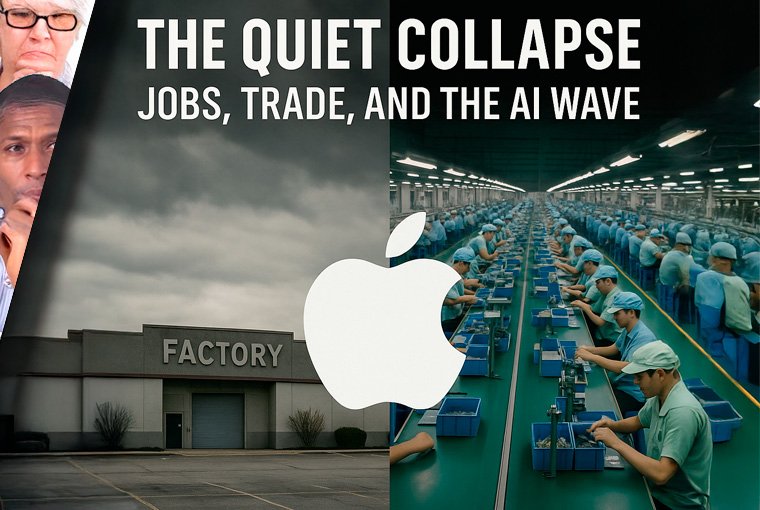
Apple’s dependence on China, decades of offshoring, and a distracted political class masked a deeper betrayal of working people. Now, manufacturing decline and fast-moving automation are building a perfect storm that few are prepared for. Forbes+1
For years America chased cheaper prices and fancier quarterly returns while corporations quietly moved the factories that once made our middle class. The result: a hollowed manufacturing base, millions of lost jobs, and an economy more fragile than most political speeches admit. Now add rapid AI-driven automation on top of that — and the slow drip becomes a landslide. Bureau of Labor Statistics+1
The Apple case study: profit first, resilience second
Apple is a useful symbol because it shows how the calculus worked: keep prices high at home to preserve a luxury image, outsource production to squeeze margins, and let supply-chain scale live where labor is cheaper. That bet worked — until geopolitics and market competition turned it into a liability. Analysts note Apple’s huge exposure to Chinese factories and suppliers, and that dependence is now a strategic risk as politics and consumer tastes change. Forbes+1
Apple is trying to diversify production — expanding India and Vietnam assembly and securing US suppliers for key inputs — but that pivot costs money and time; it can blunt risk, but it won’t instantly replace the tens of thousands of U.S. jobs lost over decades. TechNewsWorld+1
Why the mainstream story misses the point
Politicians deploy red herrings — culture wars, security fears, personality scandals — while the structural shift happens quietly in corporate boardrooms. Wall Street rewarded companies for squeezing labor costs and maximizing margins, not for investing in national resilience. The result is not a single villain but a system: corporate incentives, passive consumer tolerance for “cheap,” and political actors who benefit from distraction. The true casualty is the working class. (See manufacturing employment trends and official stats.) Bureau of Labor Statistics+1
The compounding threat: AI is not a future risk — it’s already reshaping work
Automation and AI will amplify what offshoring started. Major studies find millions of jobs globally are at risk of displacement or profound change within a decade; many routine and even white-collar tasks are now vulnerable. That doesn’t mean there won’t be new roles, but it does mean large numbers of workers will need retraining, social support, and time — things our current institutions aren’t set up to provide at scale. McKinsey & Company+1
What we’re letting happen — and why it matters
Honest choices we should be talking about
A call to urgency
This isn’t a distant hypothetical. Manufacturing job counts and month-to-month losses are real data points; AI adoption is accelerating inside companies today. The path forward requires honest conversation about tradeoffs — and a public that won’t be deceived by red herrings. Demand the math, the timelines, and the plan, not slogans. Bureau of Labor Statistics+1
No comments yet. Be the first to comment!